Reduced dependence on collateral
Eligible credit facilities may be available without conventional collateral security, depending on the lender's assessment and applicable scheme conditions.
MSME finance · Credit guarantee · Ahmedabad
If you are a small business owner looking for business finance without traditional collateral, the CGTMSE scheme can be an option worth exploring. CGTMSE supports eligible Micro and Small Enterprises (MSEs) by providing credit guarantee coverage to eligible lending institutions.
How do you apply? You generally apply for a loan through an eligible bank or lending institution. The lender evaluates your business, financial position, creditworthiness, and loan requirement. If the facility is eligible, the lender can seek CGTMSE guarantee coverage according to the applicable scheme guidelines.
Apply via a bank / MLI
Not a CGTMSE portal loan
Guarantee to the lender
Reduces credit risk
Ahmedabad MSMEs
Organised files help
For businesses looking for CGTMSE loan registration in Ahmedabad, understand eligibility, documents, the application process, and lender requirements before you start. Also see our CGTMSE scheme overview and government MSME loan guide.
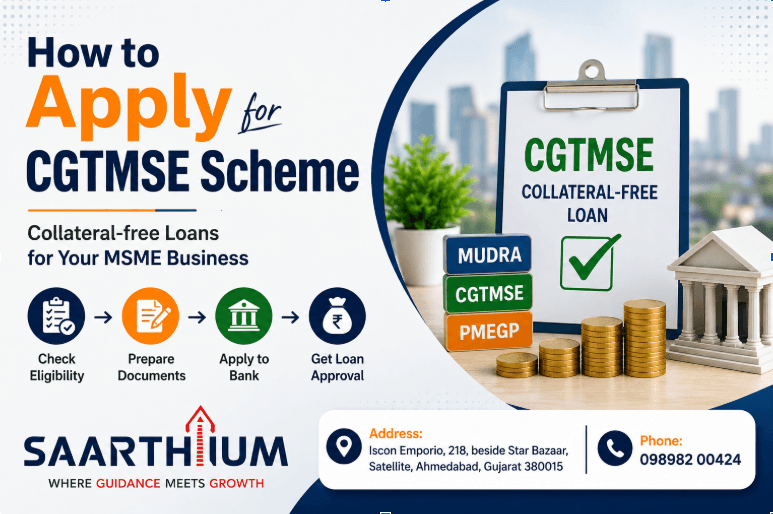
CGTMSE stands for Credit Guarantee Fund Trust for Micro and Small Enterprises. It was established to support access to institutional credit for eligible micro and small enterprises.
CGTMSE does not directly give loans to business owners. Eligible lending institutions provide credit and may obtain guarantee coverage under the CGTMSE framework.
This can help eligible businesses access credit without depending entirely on traditional collateral security, subject to the lender's assessment and applicable scheme conditions. For how guarantee schemes sit beside other products, read PMEGP vs CGTMSE vs MUDRA and how credit guarantee schemes support MSMEs.
The CGTMSE application process can generally be understood in these steps. The exact process can vary depending on the lending institution, type of credit facility, borrower profile, and current CGTMSE guidelines.
CGTMSE is primarily designed to support eligible Micro and Small Enterprises seeking institutional credit. Eligibility depends on factors such as the nature of the business, applicable MSME classification, type of credit facility, lender requirements, and current CGTMSE rules.
Before applying, a business should have:
Eligibility should always be confirmed against the latest applicable guidelines because scheme conditions can change. Udyam registration is often expected for MSME-linked credit discussions.
No. CGTMSE is not a direct loan provider.
You normally approach an eligible participating bank or lending institution for the business loan. The lender evaluates your application and, where applicable, obtains CGTMSE guarantee coverage.
Therefore, businesses should be careful about websites or individuals claiming that CGTMSE itself directly approves and disburses loans. See also guaranteed business loan myths.
The exact documents depend on the lender and the type of business. Common documents may include:
Other papers may be requested by the lender. Keeping these documents updated can make the application process more efficient. If a file was previously declined, review MSME loan rejection reasons before you reapply.
A simplified example can help explain the process.
An eligible small business needs funding to purchase equipment and expand operations.
The business approaches a participating lender and submits financial information, project details, and a loan proposal.
The lender evaluates the application. If it approves an eligible credit facility and decides to obtain CGTMSE coverage, it can apply for the applicable guarantee.
The guarantee mechanism is designed to reduce the lender's credit risk. It does not remove the borrower's responsibility to repay the loan.
The phrase CGTMSE collateral-free loan in Ahmedabad is commonly used for eligible business credit facilities that are supported by CGTMSE guarantee coverage without conventional collateral security, subject to the applicable rules and lender policies.
However, collateral-free does not mean:
The lender can still evaluate your business, financial records, credit history, cash flow, and repayment ability. A clear business loan application still matters.
Businesses searching for CGTMSE loan registration in Ahmedabad should understand that the application is generally handled through an eligible lending institution rather than by submitting a normal direct loan application to CGTMSE.
Understanding the nature and financial position of your business.
Determining the amount required and how it will be used.
Preparing financial, business, identity, and supporting documents.
Explaining the business plan, investment, expected revenue, and repayment capacity.
Submitting the proposal to an eligible lending institution.
Where applicable, the lender handles the CGTMSE guarantee application.
Applying for business finance can involve financial statements, project reports, business documents, and lender-specific requirements. Consultants may assist with preparation and organisation of these requirements.
Consultants cannot guarantee approval. The lending institution makes the final credit decision after evaluating the application.
Eligible credit facilities may be available without conventional collateral security, depending on the lender's assessment and applicable scheme conditions.
The credit guarantee mechanism can encourage participating lenders to extend credit to eligible micro and small businesses.
Funding can potentially support eligible requirements such as working capital, machinery, equipment, or expansion.
Businesses with limited assets to offer as conventional security may find the scheme useful if they meet eligibility and credit requirements.
Check your business category, registration, activity, and applicable scheme conditions.
Prepare a realistic calculation based on your business requirements.
Review your cash flow and expected income before borrowing.
Organise bank statements, tax records, financial statements, and other documents.
The loan application generally goes through a participating lending institution.
Review interest rates, repayment period, fees, guarantee-related charges, and other conditions before accepting the facility.
1. Applying without a clear business plan
A lender needs to understand why you need the money and how the business will generate sufficient cash flow for repayment.
2. Providing incomplete documents
Missing documents can slow down the assessment process.
3. Requesting an unreasonable loan amount
Your requested funding should be supported by your actual business requirements.
4. Assuming approval is guaranteed
CGTMSE guarantee coverage does not automatically mean your loan will be approved.
5. Ignoring credit history
Your credit profile can be an important part of the lender's assessment.
6. Using incorrect information
Always provide genuine and accurate business and financial information.
Saarthium helps businesses understand the documentation and financing process associated with business loans and MSME funding. The focus is on preparing a clear application, organising relevant documents, understanding lender requirements, and presenting the business proposal properly.
Knowing how to apply for the CGTMSE scheme is the first step. A CGTMSE-backed facility can potentially reduce dependence on traditional collateral for eligible businesses, but approval is still subject to the lender's credit assessment and current scheme requirements.
35% credit-linked subsidy, documents, and the PMFME loan process for food processing MSMEs in Ahmedabad.
Eligibility, documents, and the real application path through a lender for collateral-light MSME credit.
CIBIL, GST vs bank mismatch, documents, and a fix-first checklist before you reapply.
Compare subsidy, credit guarantee, and MUDRA micro loans with a simple decision guide.
MSME classification, CGTMSE context, procurement, and delayed payments, without confusing registration with guaranteed loans.
What Udyam, CGTMSE, and Startup India actually mean for credit, and what banks still evaluate.
Learn about Section 80-IAC tax exemption and how to get zero tax on your business.
Complete guide to PMEGP loan scheme for MSMEs and startups.
Get seed funding up to ₹50 lakh through Startup India scheme.
Access collateral-free loans up to ₹2 crores for your business.
Have a question about funding, registration, or compliance? Send us a note and our team will reach out shortly.
Get weekly tips, funding opportunities, and compliance updates delivered to your inbox.
By subscribing, you agree to our Privacy Policy. Unsubscribe anytime.