Small businesses often need financial support to purchase machinery, manage daily expenses, increase inventory, hire employees, or expand their operations. An MSME loan can help business owners arrange the funds required to achieve these goals. However, before applying, it is important to understand the MSME loan eligibility criteria and the documents required for approval.
In India, banks and financial institutions offer different types of business loans to micro, small, and medium enterprises. Understanding the eligibility requirements can help entrepreneurs prepare a stronger application and choose suitable financing options. Business owners looking for MSME Loan Registration In Ahmedabad should also understand how Udyam Registration, business turnover, credit history, and repayment capacity affect their loan applications.
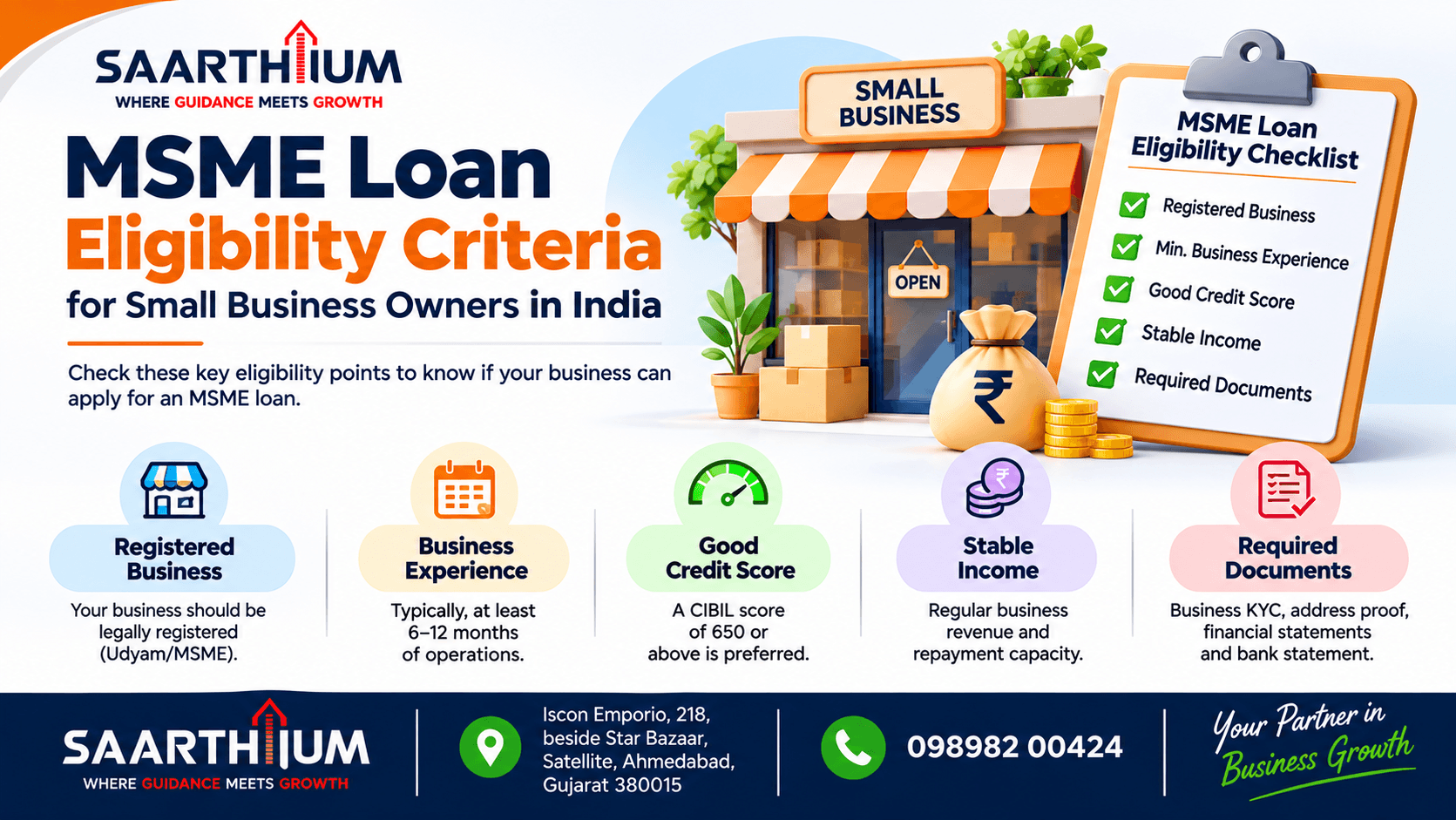
What Is an MSME Loan?
An MSME loan is a type of business financing designed to support micro, small, and medium enterprises. Business owners can use these loans for business expansion, purchasing equipment, managing working capital, buying raw materials, or meeting other business requirements.
MSME loans are available through banks, NBFCs, and eligible government-supported lending schemes. Depending on the lender and loan scheme, applicants may receive secured or unsecured financing.
These loans can support different types of businesses, including manufacturing units, service providers, traders, retailers, and small enterprises.
What Are the MSME Loan Eligibility Criteria for Small Business Owners?
MSME loan eligibility depends on several factors, including business registration, financial performance, credit history, and repayment capacity. Although requirements differ between lenders, the following are common eligibility considerations.
1. Business Should Qualify Under MSME Classification
The applicant's business should fall under the applicable MSME classification. From 1 April 2025, the revised MSME classification is based on investment in plant and machinery or equipment and annual turnover.
The current classification limits are:
- Micro Enterprise: Investment up to ₹2.5 crore and annual turnover up to ₹10 crore.
- Small Enterprise: Investment up to ₹25 crore and annual turnover up to ₹100 crore.
- Medium Enterprise: Investment up to ₹125 crore and annual turnover up to ₹500 crore.
These limits help determine whether a business qualifies as a micro, small, or medium enterprise.
2. Valid Business Registration
Business registration helps establish the legal identity and operational details of an enterprise. Applicants may need to provide relevant business documents, depending on their business structure.
Udyam Registration is particularly important for businesses seeking MSME recognition. It provides an official registration certificate that can support access to applicable MSME benefits and lending facilities.
Business owners who need assistance can explore a Udyam Registration Service In Ahmedabad to understand the registration process and prepare the required information.
3. Good Credit Score and Repayment History
A business owner's credit profile can influence loan approval. Banks and financial institutions generally review the applicant's credit history to understand previous borrowing and repayment behaviour.
A good credit score, timely EMI payments, and responsible credit usage may improve the chances of loan approval. However, the minimum credit score requirement varies between lenders.
Applicants should check their credit reports and resolve outstanding payment issues before submitting a new loan application.
4. Stable Business Income and Turnover
Lenders evaluate business income to understand whether the enterprise can repay the proposed loan. Businesses with consistent sales, regular income, and healthy cash flow may have a stronger application.
Applicants may need to provide bank statements, income tax returns, GST returns, and financial statements to demonstrate business performance.
5. Minimum Business Experience
Some lenders prefer businesses with an established operating history because it helps them evaluate financial stability and repayment capacity.
However, the minimum business experience requirement depends on the loan product and financial institution. New businesses may also explore specific startup financing options and government-supported schemes.
6. Repayment Capacity
Repayment capacity is another important factor in MSME loan approval. Lenders examine existing EMIs, monthly income, business expenses, outstanding liabilities, and expected cash flow.
Before applying, business owners should calculate how much monthly EMI their business can comfortably manage. Applying for an amount that matches the actual financial requirement can help create a more practical repayment plan.
What Documents Are Required for an MSME Loan?
The documents required for an MSME loan may vary depending on the lender, loan amount, and business structure.
Commonly requested documents include:
- Aadhaar card and PAN card of the applicant.
- Business registration documents.
- Udyam Registration Certificate, where applicable.
- GST registration certificate, where applicable.
- Bank statements for the required period.
- Income tax returns.
- Business financial statements.
- Proof of business address.
- Details of existing loans and financial liabilities.
- Business project report, if required.
Preparing these documents in advance can help reduce application delays.
How Can Udyam Registration Help in MSME Loan Applications?
Udyam Registration provides official recognition to eligible micro, small, and medium enterprises. It can help businesses access applicable government schemes, priority sector lending benefits, and other MSME-related facilities.
Registration is completed through the official government portal and is free of charge. Businesses can register online using the required Aadhaar and PAN-linked information.
However, Udyam Registration does not automatically guarantee loan approval. Financial institutions still evaluate the applicant's creditworthiness, business performance, and repayment capacity.
How to Apply for an MSME Loan in Ahmedabad?
Small business owners in Ahmedabad can follow these steps when applying for an MSME loan:
- Check business eligibility: Confirm that your enterprise meets the applicable MSME classification.
- Complete Udyam Registration: Obtain the registration certificate if your business is eligible and not already registered.
- Prepare financial documents: Collect bank statements, GST returns, income tax returns, and other required records.
- Choose a suitable loan option: Compare interest rates, repayment periods, processing fees, and eligibility requirements.
- Submit the application: Apply through the selected bank or financial institution.
- Complete verification: Respond to any additional document or verification requests.
- Review loan approval: Carefully check the approved amount, interest rate, EMI, and repayment terms before accepting the offer.
Business owners seeking professional guidance can consult an MSME Loan Consultant In Ahmedabad to understand the application requirements and available financing options.
How Can Saarthium Help with MSME Loan Registration?
Understanding loan eligibility, arranging documents, and selecting suitable financing options can be challenging for small business owners. Saarthium can be approached for guidance related to MSME loan registration, Udyam Registration, and business funding assistance.
With the right preparation, entrepreneurs can better understand the application process, organise their business documents, and explore financing opportunities based on their requirements.
If you are planning to expand your business, purchase machinery, or arrange working capital, understanding the eligibility criteria is an important first step.
Frequently Asked Questions (FAQs)
1. Who is eligible for an MSME loan in India?+
Micro, small, and medium business owners who meet the applicable MSME classification and lender-specific requirements can apply for MSME loans. Approval depends on factors such as business income, credit history, and repayment capacity.
2. Is Udyam Registration mandatory for an MSME loan?+
Udyam Registration is important for MSME recognition and accessing applicable benefits. However, specific registration requirements depend on the lender and loan scheme.
3. Can a new business apply for an MSME loan?+
Yes, new businesses may explore suitable business financing options. However, lenders may have additional requirements related to business plans, project costs, promoter profiles, and repayment capacity.
4. Can I get an MSME loan without collateral?+
Yes, eligible micro and small enterprises may access collateral-free financing under applicable lending arrangements and credit guarantee schemes. Approval remains subject to lender assessment and scheme conditions.
5. How can I apply for MSME Loan Registration in Ahmedabad?+
You can begin by checking your business eligibility, completing Udyam Registration where applicable, preparing financial documents, and approaching a suitable bank or financial institution. Professional guidance from Saarthium may also help you understand the process.
Conclusion
MSME loans can provide important financial support to small business owners who want to establish, manage, or expand their businesses. Before applying, check your MSME classification, business registration, credit history, financial records, and repayment capacity.
Whether you are an entrepreneur starting a new venture or an established business owner planning expansion, proper preparation can make the loan application process easier. Understanding the eligibility requirements and choosing the right financing option can help your business move towards sustainable growth.